
Working with toddlers and preschoolers over 20 years as a speech therapist, I understand why parents tell me, “They don’t sit long enough to listen to books,” and “They don’t like books.” One truth and one falsie😉 No, they may not sit long enough but do they really dislike books??
Kids are busy little humans. I will even go out on a limb and say since COVID, kids are even busier than they were before! We live in a world of phones, tablets, blue light and needing that instant gratification that electronics give us.
But what if I told you books are a big key to your child’s academic success. Would you believe it? Would it make you change the environment at home?
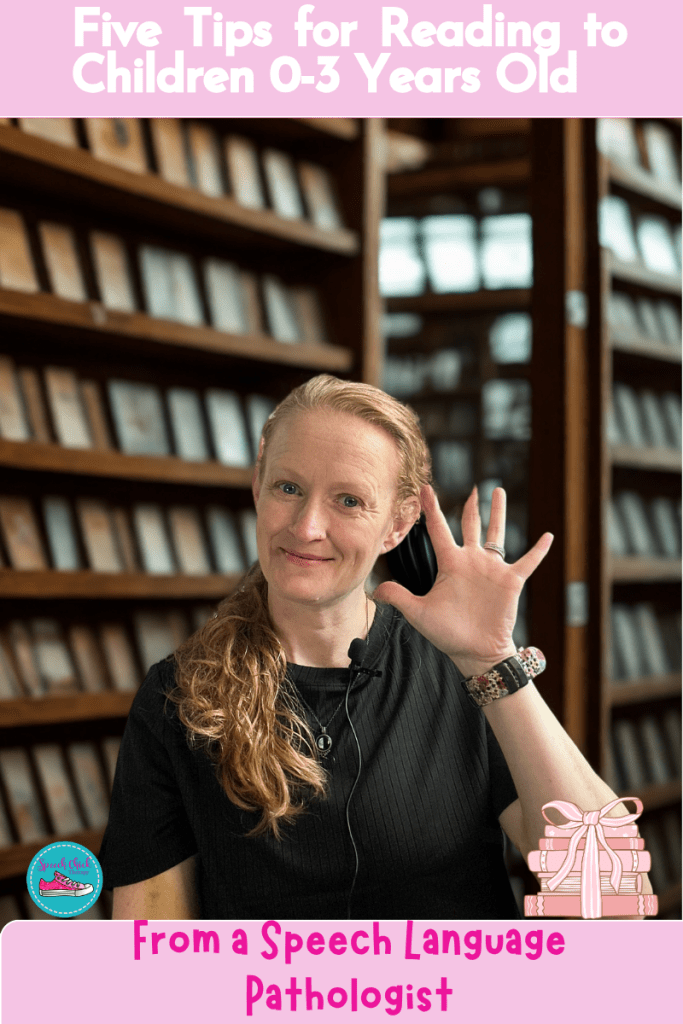
I am sharing 5 tips to help you read to your child at home and make it fun!
Tip #1: It’s All About the Environment Baby!
Think about when you sit down to read. You have a cozy spot. All electronics or distractions are put away or turned off. You might even have that emotional support drink and/or snack close by. The same applies to children…especially toddlers and preschoolers!!
- Set up a cozy spot. Maybe it’s a comfy chair in their room or in the corner of the family room. It could be as simple as big floor pillows or a bean bag chair. MAKE IT COZY!
- Positioning is important! The floor is the perfect spot because you can place your child ACROSS from you…NOT in your lap!
- Do not start the book with the intention of reading the entire thing! You may have to break it up over the week. You may not read one single word in the book. With toddlers I seldom read the text in the book. We talk about the pictures!
- Minimize distractions. Elaboration is not needed for this one. It would just cause more of a distraction.😉🤣
- Story Prop Boxes bring the book to life! Grab animals if your child chose “Brown Bear Brown Bear What Do You See?” or cars for their favorite transportation book.
- Set a few books at a time and ROTATE. Place the books so that the cover faces out, not the spine. Toddlers and preschoolers are judging books by their covers! Many caregivers do this with toys. The same rule can apply. When it’s time to rotate toys, rotate books too!
Tip #2: REPETITION IS AWESOME!
I have had “Brown Bear” in my bag for almost a year. I have one or two kids that get it out every session. Sometimes, we read it. By now, they “read” it to me. Sometimes, we sing it. Other times, we may use silly voices with each animal. The point is I could probably recite it backwards if my life depended on it. Book REPETITION is huge in language development! There is study that found children hearing the same book repeatedly had better retention of new words compared to kids who were read different books containing the same word. (did you hear that? the mic just dropped!) So what are we as caregivers to small children going to do tonight? Yep, read that book AGAIN tonight when they ask.
Tip #3: WAITING IS EVEN MORE AWESOME!
…See how I started this tip waiting? What did it give you time to do? Hopefully, it gave you time to process what I had just said…”waiting is even more awesome!”
The same happens when you pause with a small child. Before you ever read or say a word, hand the book to the child and just wait. What do they do with it? Do they hand it back and suggest “hey read this”? Do they take it, sit down and open it? Give them time with the book.
Tip #4: I REPEAT…THIS IS NOT A TEST!
Again, think back to your own reading time. Whether it’s reading directions for assembling the famous Swedish furniture or a book of your choosing…(see that wait time?😉) Is someone quizzing you over everything you just read? NO! So stop doing it to your child! The next time you read with your child, make it your sole goal to NOT ask (even once) “What’s this?” Better yet, everytime you ask that question, give your child an M&M. Once your little one has earned an entire bag of the”share size,” you’ll probably quit asking it!
What do you do instead? Elaborate about the pictures. Talk about what YOU see in the pictures. Model language that your child needs to hear to teach them to be good communicators.
Tip #5: MOVEMENT BRINGS THE STORY ALIVE
Use gestures. Point to things (while modeling, not testing) you see in the story. Make animal noises. Stretch your arms to show “BIG” or put your fingers close together to show “SMALL.” Make a muscle to show strong Use facial expressions accordingly. This is one tip that requires no planning on your part when that book opens up!
The most important thing to remember is JUST ENJOY THE EXPERIENCE! There is HUGE power in 1 book a day…by the age of 5, children who are just one book a day have heard about 290,000 more words than a child who has not been read to daily.

 speechchicktherapyblog.com